Published
- 9 min read
GPU vs TPU for Quant Models: Cost vs Speed Trade-offs
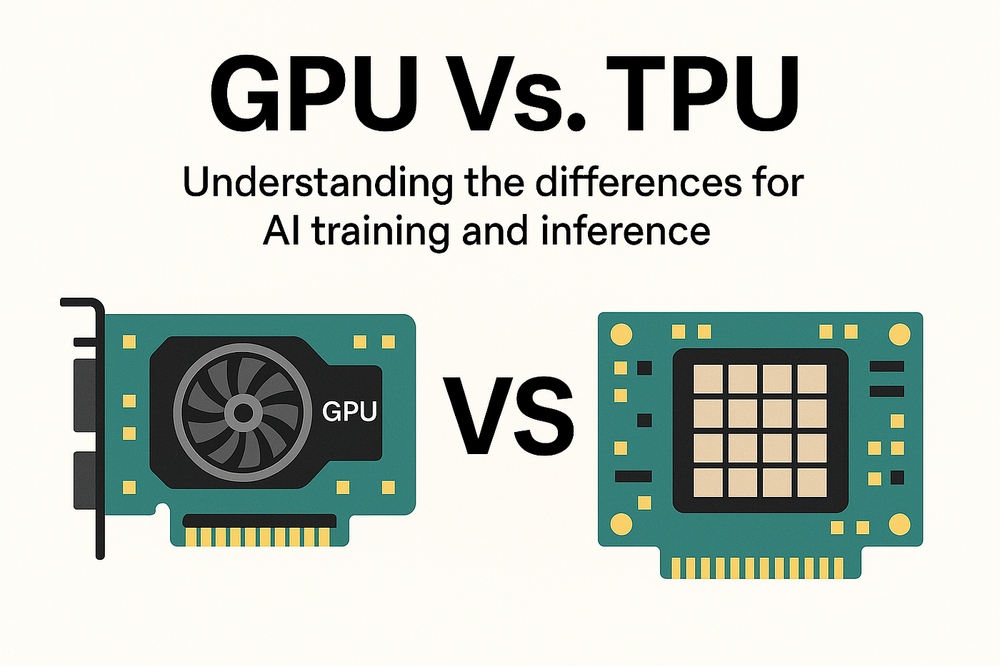
GPU vs TPU for Quant Models: Cost vs Speed Trade-offs
A long-form, quant-focused guide to choosing the right accelerator for pricing, backtesting, and ML alpha research.
Why GPUs vs TPUs matters for quants
Most quant shops that “do AI” still run a mixed stack: Python + NumPy/Pandas for research, some C++ for legacy pricing libraries, and GPUs bolted on for the heavy lifting. The rise of Google’s TPUs introduces a serious question: for quant cost vs speed, should you stick with GPUs, or is it worth moving some workloads onto TPUs?
In 2025, several large AI users reported that Google TPUs deliver roughly 4× better cost-performance than Nvidia GPUs for inference-heavy workloads, with companies like Midjourney cutting inference bills by around 65% after switching from GPUs to TPUs. At the same time, detailed benchmarking by independent hardware analysts suggests that for some LLM workloads, well-priced H100/B200 GPU clusters still beat TPUs on cost per million tokens, especially outside Google Cloud.
For quants, the key is not “which is absolutely better?” but: for your specific workload—Monte Carlo pricing, VaR, factor models, LOB networks, execution agents—what gives the best ratio of model throughput per dollar and engineering pain per hour?
Architecture differences in plain language (for quant workloads)
GPUs: general-purpose, flexible accelerators
Nvidia GPUs are massively parallel processors originally built for graphics, now repurposed for numeric workloads via CUDA.
For quant tasks, this means:
-
They excel at:
- Monte Carlo simulations where you can run millions of independent paths in parallel.
- Linear algebra heavy models: factor regressions, PCA, covariance updates, deep nets in PyTorch.
- Mixed workloads where you combine simulation, feature engineering, and ML in one pipeline.
-
They support:
- PyTorch, TensorFlow, JAX, CuPy, RAPIDS, Numba, and a large ecosystem of quant-compatible libraries.
Think of GPUs as highly programmable engines: if it can be written as vectorized code or kernels, you can probably make a GPU go fast.
TPUs: specialized tensor engines
TPUs (Tensor Processing Units) are ASICs designed by Google specifically for tensor operations—matrix multiplies and convolutions—organized as systolic arrays.
For quant:
-
They excel at:
- Large, dense neural networks—transformers, LSTMs, big MLPs—for signal modeling, order book modeling, or macro forecasting.
- Very high throughput inference when the workload can be batched and is not too branchy.
-
They are tightly integrated with:
- Google Cloud.
- JAX and TensorFlow as the primary software stacks.
Architecturally, a TPU is like a hard-wired matrix engine: fantastic if your workload is “multiply huge matrices all day,” less ideal if you have lots of if/else branches, path-dependent payoffs, or irregular data structures.
Branchy pricing logic vs pure tensor math
This is where quant specifics matter:
- Path-dependent derivatives with knock-outs/early exercise, credit exposure paths, or multi-asset barriers have a lot of branches and conditional logic.
- Deep limit-order-book models, execution policies, or LLM-based research tools are closer to pure tensor workloads.
Rule of thumb:
- Branchy Monte Carlo / XVA / exotic Greeks → GPUs usually win.
- Large neural nets for signals / execution / NLP → TPUs can be compelling if you live in JAX/TF.
Cost and speed: concrete numbers
Cloud pricing snapshots (2025–2026 ballpark)
Below is an approximate view of on-demand pricing per chip-hour from public sources and cloud benchmarks (exact numbers vary by region/provider):
| Accelerator | Typical on-demand price per chip-hour | Notes |
|---|---|---|
| Nvidia H100 | ~5+ | Hyperscalers; some niche clouds claim ~3 as floor. |
| Nvidia H100 (best deals tracked) | ~$2.50 | Lower bound in some price trackers. |
| TPU v5e | ~$1.20 | On-demand; down to ~$0.55 with 3-year commits. |
| TPU v6e (Trillium) | ~$1.38 | On-demand; some claims of ~1.375 range. |
Several analyses claim that for large transformer inference workloads, TPU v5e/v6e can deliver around 4× better performance-per-dollar vs H100 when you stay inside Google Cloud and use supported frameworks.
At the same time, some independent benchmarks find that H100/B200 systems can achieve lower cost per million tokens than TPU v6e on certain Llama workloads, assuming access to the very cheapest GPU cloud prices.
The key conclusion: there is no universal winner; outcome depends heavily on:
- Which cloud you use.
- Your commitment discounts and preemptible usage.
- How well your model is optimized for each platform.
An example: training a mid-sized quant model
Imagine training a mid-sized LOB model or execution policy network that takes 100 GPU-hours per epoch on a single H100, and you need 10 epochs:
-
On H100 at $3/hour:
- Cost ≈ 1,000 GPU-hours × 3,000.
-
On TPU v6e at $1.38/hour (assuming similar time-to-train, which is workload-dependent):
- Cost ≈ 1,000 TPU-hours × 1,380.
-
On TPU v6e with long-term commitment at $0.55/hour:
- Cost ≈ 1,000 TPU-hours × 550.
If your model is well-optimized for TPUs (large batches, JAX/TF, minimal custom ops), TPUs can plausibly give you 2–5× cheaper training for that specific deep-net workload.
The inference tsunami
For quant shops, inference often dominates long-term cost:
- Many analyses estimate that inference can cost an order of magnitude more than training over a model’s lifetime, especially for LLMs and large recommendation models.
- Projections suggest inference may account for the majority of AI compute by the end of the decade, representing a very large and fast-growing spend category.
Examples reported:
- Some image-generation and LLM applications have reported ~50–70% cuts in inference costs after migrating to TPUs.
- A mid-sized AI app serving around 1M queries/day can see annual cost drop from roughly low-seven figures on H100 to low- to mid-six figures on TPU with commitments in some modeled scenarios.
For a quant context, think about:
- Intraday signal scoring for thousands of instruments every few seconds.
- Execution models evaluating millions of state-action pairs.
- LLM-based research assistants used heavily across the firm.
If those are LLM/transformer-like workloads and you can batch queries, TPUs can realistically cut serving costs by a large factor at similar latency, under the right conditions.
Ecosystem, engineering friction, and lock-in
GPU strengths for quants
1. Ecosystem dominance
- PyTorch, CUDA, RAPIDS, CuPy, Numba, and a massive library ecosystem are GPU-first.
- Most academic finance and quant ML tutorials assume GPU, not TPU.
2. Mixed workloads
Typical quant pipeline:
- ETL: load+clean tick/trade/LOB or macro data.
- Feature engineering: rolling stats, options Greeks, risk factors.
- Simulation: Monte Carlo pricing/hedging or scenario analysis.
- ML: factor models, deep nets, reinforcement learning.
- Post-processing: aggregation, risk, attribution.
GPUs handle mixed numeric workloads better: you can accelerate both the simulation and the model, including branchy payoff logic and non-tensor math.
3. Portability
- GPUs run on AWS, Azure, GCP, niche clouds, and on-prem clusters.
- Easy to hedge vendor risk with multi-cloud or colo + DGX/PCIe servers.
TPU strengths and constraints
1. Tight Google ecosystem
- TPUs are effectively Google Cloud only.
- First-class support for JAX and TensorFlow; PyTorch XLA is improving but less mainstream in quant.
2. High leverage for “pure” ML
If your main quant workloads are:
- Big JAX/TensorFlow models for execution, pricing, or factor prediction.
- LLM-based tools heavily used by the firm.
You can get:
- 2–4× better performance-per-dollar on well-optimized models.
- Better power efficiency per query compared to some GPU baselines.
3. Engineering cost
The big friction for a typical quant stack:
- Porting PyTorch+CUDA code to JAX/TF (or PyTorch/XLA).
- Rewriting custom quant logic that isn’t pure tensor math.
- Adapting workflows and tooling to live inside GCP.
For small teams, engineer-hours can be more expensive than GPU-hours; the migration only makes sense when your inference/training bill is already large.
Concrete quant use cases: GPU vs TPU
Case 1: Monte Carlo VaR and exotic pricing
Workload:
- Path-dependent derivatives.
- American-style optionality, barriers, callable structures.
- CVA/DVA/FVA with multi-factor models and wrong-way risk.
- Branch-heavy payoff logic.
Characteristics:
- Lots of branching, early-exercise conditions, discontinuities.
- Some linear algebra (Cholesky, factor rotations) but dominated by path simulation and payoff logic.
Best fit:
- GPUs win here in practice because:
- CUDA and GPU-friendly Monte Carlo libraries are mature.
- Branching and irregular memory patterns are handled better.
- Codebases are typically C++/CUDA or Python+Numba → natural GPU targets.
Case 2: Cross-sectional factor models and PCA
Workload:
- Massive cross-sectional regressions (e.g., 5,000–20,000 names).
- Rolling PCA / SVD on factor covariance matrices.
- Linear or shallow non-linear models.
Characteristics:
- Heavy linear algebra.
- Not too much branching.
- Often written in NumPy/BLAS/LAPACK.
Best fit:
- If you move to CuPy/RAPIDS, GPUs can accelerate this easily.
- TPUs could work if written in JAX/TF, but the ecosystem advantage is smaller; both accelerate matmuls well.
- Here, the decision is mostly about ecosystem and lock-in, not raw FLOPs.
Case 3: Deep limit-order-book models and execution policies
Workload:
- LSTMs/Transformers on LOB snapshots.
- Actor-critic policies for optimal execution.
- Large batched inference at high frequency.
Characteristics:
- Heavy tensor math (matmuls, attention).
- Limited branching within the model.
Best fit:
- This is where TPUs start to shine:
- Deep models in JAX/TF can get significantly better cost-performance vs GPUs.
- If your desk uses one large execution model across all instruments, inference volume is huge → TPU cost advantage matters.
Case 4: LLM-based quant research tools
Workload:
- Internal “Copilot for research” summarizing filings, papers, broker reports.
- RAG systems over proprietary research notes.
- Heavy inference, not much training.
Characteristics:
- LLM inference is dominant cost.
- Models may be fine-tuned but mostly used in production.
Best fit:
- If you’re on GCP and happy with JAX/TF/vLLM stacks, TPUs are strong candidates for the LLM tier, especially when your inference load is high and predictable.
A decision framework for a quant shop
1. Workload fit
| Question | If YES → Bias |
|---|---|
| Is the workload dominated by dense tensor operations (matmuls, attention) with minimal branching? | TPU |
| Is the workload branch-heavy (path-dependent payoffs, early exercise, complex logic)? | GPU |
| Is it mixed (ETL, Monte Carlo, ML, reporting) in one pipeline? | GPU |
2. Ecosystem and people
| Question | If YES → Bias |
|---|---|
| Is your team deeply invested in PyTorch/CUDA? | GPU |
| Are you already using JAX/TF at scale on GCP? | TPU |
| Do you require multi-cloud or on-prem deployment for regulatory reasons? | GPU |
3. Cost scale
| Question | If YES → Bias |
|---|---|
| Is your model training bill < $5–10K/month? | GPU (no need to optimize yet) |
| Is your inference bill > $20K/month and growing fast? | Evaluate TPUs seriously |
| Can you commit to multi-year contracts and preemptible instances? | TPU economics improve further |
4. Operational risk
-
Vendor lock-in:
- TPUs tie you to GCP.
- GPUs allow AWS/Azure/GCP/niche clouds + on-prem.
-
Engineering risk:
- TPU migration requires code changes and platform alignment.
- GPUs are almost plug-and-play with existing quant ML code.
Bottom line for quants
-
GPUs are still the default choice for:
- Monte Carlo pricing and XVA.
- Backtesting engines with complex control flow.
- General quant research where flexibility dominates.
-
TPUs are increasingly compelling for:
- Large, production deep nets (LOB models, execution, macro).
- LLM-based internal tools where inference dominates cost.
- Shops already committed to Google Cloud and JAX/TF.
At small scale, you will rarely “feel” the TPU advantage; your bottleneck is more often data quality, model design, and researcher time than raw FLOPs per dollar. Once your compute bill crosses into serious six- or seven-figure territory and your workloads are cleanly tensorized, not exploring TPUs starts to look like leaving basis points on the table.
For a quant, the right mental model is not “GPU vs TPU fanboy war,” but: what is my true cost per useful model evaluation, end-to-end, including engineering time, cloud spend, and governance constraints? For some desks, that will keep the answer firmly in GPU-land. For others, especially deep-learning heavy execution and LLM tool stacks, the optimal portfolio will be hybrid: GPUs for research and simulation, TPUs for the heavy production inference that actually moves PnL.